
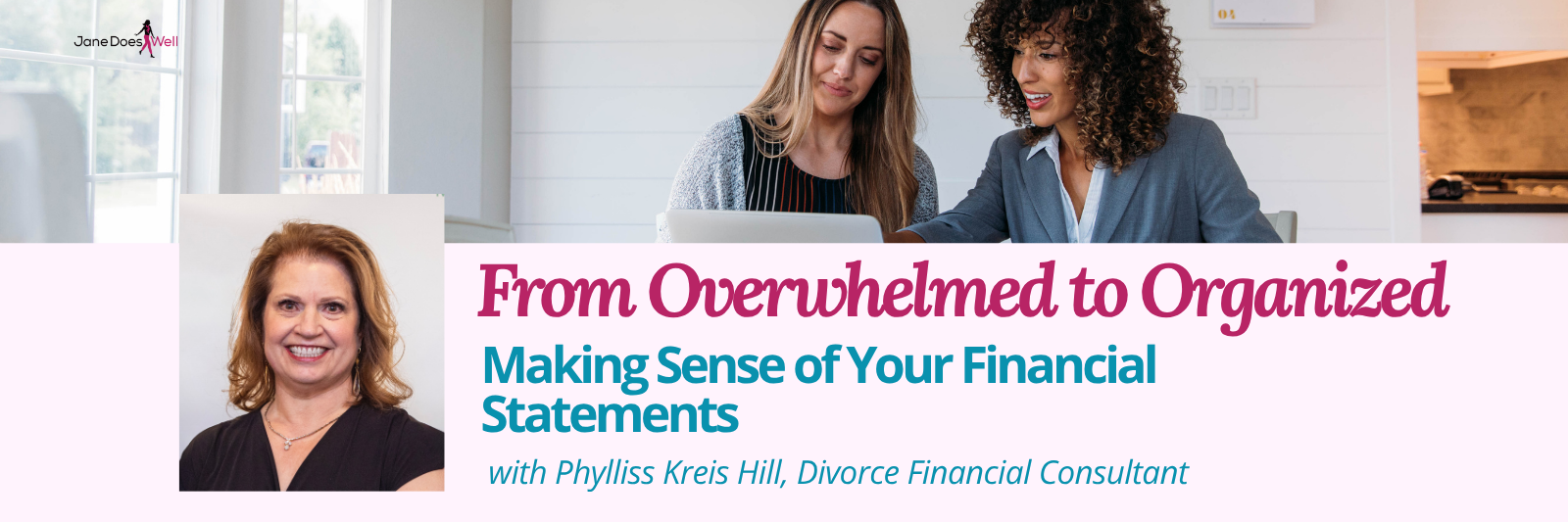
From Overwhelmed to Organized: Making Sense of Your Financial Statement
Jun 23, 2026
If you've ever stared at a financial statement during your divorce and felt your stomach drop, please know you are not alone. Most women come into this process without a roadmap, and that's not a personal failing. It's just where they are. The good news is that understanding your finances is absolutely learnable, and having the right guide makes all the difference.
Phylliss Kreis Hill is a Divorce Financial Consultant who has walked countless women through exactly this — from that first overwhelming moment to feeling informed, prepared, and genuinely in charge. We asked her the questions we hear most from our community, and what she shares below is reassuring, practical, and worth reading slowly.
JDW: Data reveals that women are statistically more vulnerable to post-divorce economic decline. Not because the law fails them, but because they didn't know what they didn't know. In your experience, how much does a woman's financial literacy at the start of the process affect where she ends up at the end of it?
PHYLLISS: Firstly, for simplicity, I will respond with a few basic assumptions, 1) husband/wife are divorcing, there are children, and children remain slightly more with wife, but with recognition that we have members who are part of same sex couples who are divorcing, and 2) husband is the higher earner, recognizing that we have members where the wife is the higher earner.
Understanding what a wife could be legally entitled to before even speaking with an attorney is critical. In fact, that's where I often start with my clients. We work through potential support calculations for child support, alimony, and/or both, I run through Cavanagh calculations, often using multiple scenarios, husband earning within a certain range of incomes, wife not earning an income, wife having attributed income, and wife obtaining a job PT or FT and earning an income. This results in a ballpark estimate of support.
I also work through potential settlement scenarios, how the assets could be divided, so that they can think about where the marital house fits into the equation, or not.
JDW: What is the single biggest mistake you see women make when they first encounter their financial statements — and what does it actually cost them?
PHYLLISS: If wife could possibly be entitled to alimony, the biggest mistake is under-reporting expenses. Alimony is based on several things, one being the documented need of the recipient. If the FS is prepared with lower than "typical during the marriage" expenses, it's challenging (but certainly possible, with adequate explanation) to increase those expenses on subsequent FS, particularly if opposing counsel if aggressive.
JDW: Many of the women we serve were not the spouse who managed the money. When they open these financial documents for the first time, what are they actually looking at? Why is that moment so disorienting?
PHYLLISS: I think it comes down to two things - one, being the sheer volume of documents. Sometimes, wives who did not work outside the home have computer skills that are a little out of date. Managing all these documents takes strong organization, and that's one thing I work with my clients on - creating an electronic filing system for all of the documents (not just financial documents) that need to be managed during a divorce. The second thing that's overwhelming and disorienting is getting the first look at the spending patterns of the husband, where they did not have visibility into the credit card statements during the marriage, and they see things that can be troubling.
JDW: The Financial Statement must be signed under penalty of perjury. What does it mean for a woman to sign a document like that when she genuinely doesn't know if the numbers are right?
PHYLLISS: It's very common on most if not all FS to estimate something. Simply footnote that it's an estimate based on something - and you'll be fine signing that FS under the pains and penalties of perjury. Then when you submit a subsequent FS, you are free to revise that estimate, put in an actual figure, and update the footnote.
JDW: Are there things that are commonly hidden or underrepresented in financial statements during divorce ? Things a woman would never catch without guidance?
PHYLLISS: Always. There are too many to mention. I note that some underrepresented or unreported financial items could be unintentional. I look at the tax returns, to see if there is a large overpayment with the IRS, I look at the financial institutions that are listed for dividend, interest income and capital gains/losses. I look at the Sch. C or K-1 if husband owns or operates a business, and I look at the expenses, which in many cases can be added back to arrive at the income available for support. I also look at bank statements to see if money is being transferred to /from accounts, and see if those accounts are properly disclosed. I could go on and on...
JDW: What do you wish more women knew before they walked into their first meeting with a divorce attorney, specifically about their finances?
PHYLLISS: Any and all of the above! Mainly, I see that once women understand the support calculations and how Cavanagh may/may not play in, then they have a range of what their support may look like, and they generally feel less vulnerable, as knowledge is power. Once they have a feel for what they can expect in terms of support, they can start to think about whether it makes sense to try to stay in the marital home, start to make some decisions about their own employment possibilities, etc.
JDW: What does a woman understand about her own life and her own marriage that she didn't before, once she has truly worked through these documents?
PHYLLISS: This is the best part about working with women during this process. I get to bear witness to enormous growth, gains in self-confidence, and to women finding their voice! She leaves this process informed, empowered, and in charge of her financial future. I would be remiss if I did not acknowledge that financial abuse and post-separation abuse is quite common, and anyone in that situation reading this may have some choice words for my response on this topic. I acknowledge that some women are poorly represented, have insufficient access to marital funds, have extremely abusive husbands, and face a steep uphill battle. For these women, I try to help them understand what they could be legally entitled to, help them advocate for themselves with their attorney, often jump on Zooms with their attorney, help them find new counsel - or help them in any way I can to come out of the situation.
JDW: Finally, for women who want to work with you beyond the workshop , what does that look like? What do you offer, and who is the right fit for your services?
PHYLLISS: I always do a ½ hour to 1 hour consult with anyone before I work with them. From that conversation alone, often I can guide them right away and empower them before they have that next meeting with their attorney. If discovery has been an issue, make a list of items you need. You may need to issue subpoenas. This can get the ball rolling in the right direction immediately. But in general, I take on clients where I feel I can make an impact on their case. If the primary issues are DCF/GAL/parenting issues, I can provide a little advice as a fellow mom who went through this myself, but beyond that, it's not in my wheelhouse to consult in that area.
The more organized the data, and the greater access to documents, the more I can help you prepare your financial statement. That holds true for attorneys too - which is why I help clients create organization with their divorce documents.
Want to go deeper?
Phylliss is joining us live on June 23 for From Overwhelmed to Organized: Making Sense of Your Financial Statements — a workshop designed to help you understand exactly what you're looking at, what to watch for, and how to walk into your next attorney meeting prepared. Click below to register for tonight's event!
by Megan Bresnehan | VP Digital Strategy & Communications | Jane Does Well
